


PUBLIC OFFICIALS WORK FOR UP TO 11 PUBLIC ENTITIES SIMULTANEOUSLY, EARNING CLP $22 MILLION PER MONTH
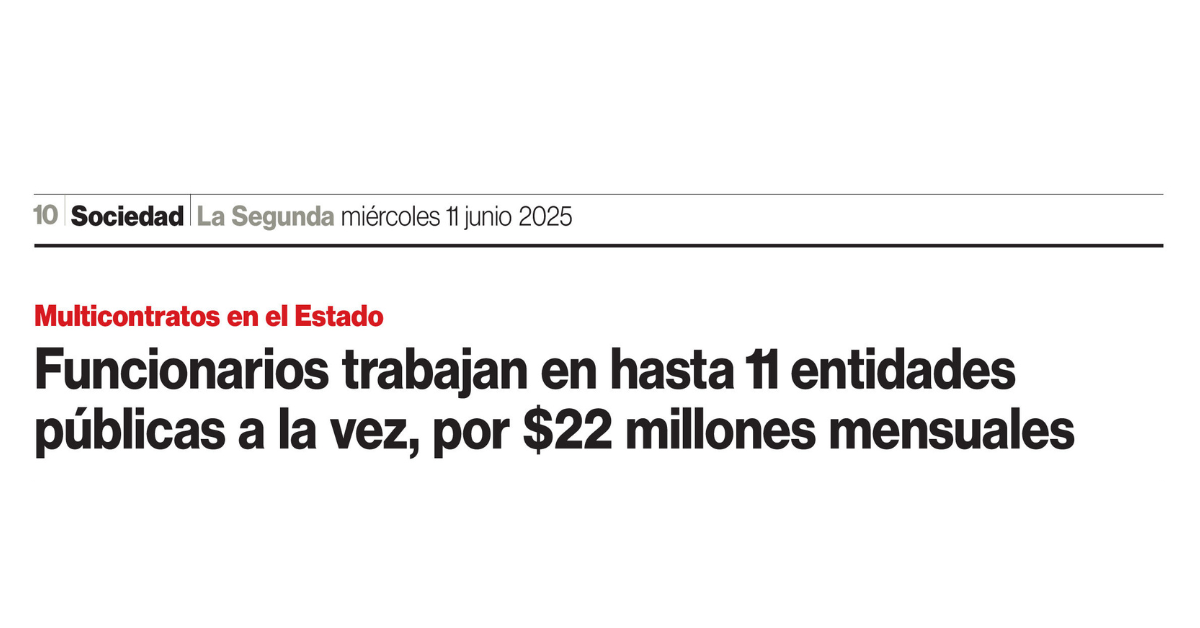
Between 2022 and 2025, nine individuals held five contracts simultaneously, while more than 100 worked for four institutions at the same time.
In October 2024, lawyer Rodrigo Flores Osorio worked for 11 public entities simultaneously, receiving total gross monthly compensation of CLP $22,840,643. The lawyer, who is affiliated with Renovación Nacional (National Renewal), was among the public officials who worked concurrently for the largest number of public entities.
This is according to a data cross-check conducted by La Segunda using information from more than 1,200 public entities—including ministries, municipalities, corporations, and public services—covering the period from 2022 to 2025. The newspaper cross-referenced transparency data on permanent staff, fixed-term public employees (a contrata), and fee-based service providers (a honorarios) to identify individuals who, within the same month and year, were recorded as working for more than one entity. In total, the outlet analyzed nearly 30 million data points.
The findings identified public officials who received more than CLP $10 million in total monthly compensation, some who worked for multiple entities simultaneously for up to three years, and others who held positions under all three employment arrangements at the same time: permanent staff, fixed-term public employees, and fee-based service providers.
The Lawyer with an “Octopus-Like” Workload
Lawyer Flores topped the ranking, having held 11 simultaneous fee-based contracts in a single month. In October 2024, he provided legal advisory services to the municipal corporations of Colina (CLP $4,057,971), Calera de Tango (CLP $2,318,841), and Curaco de Vélez (CLP $1,739,130), as well as the municipalities of Caldera (CLP $1,666,667), Chimbarongo (CLP $1,159,420), La Ligua (CLP $1,739,130), Mejillones (CLP $2,898,551), Pitrufquén (CLP $1,739,130), Pucón (CLP $1,767,885), Santo Domingo (CLP $1,753,918), and Villarrica (CLP $2,000,000). He did not respond to calls from the newspaper.
The lawyer, who has been involved in the internal structures of Renovación Nacional, also ranked second and third. He held nine simultaneous contracts in September, July, and May 2023, as well as in August and July 2024, earning between CLP $17 million and CLP $19 million per month. He also held eight simultaneous contracts in June, November, and December 2024, and March 2023, earning between CLP $15 million and CLP $16 million per month.
Further down the ranking is physician Diego Ossandón Villaseca, who held seven simultaneous contracts in December 2023, earning CLP $11,424,576 for ophthalmology services at San Borja Arriarán, San José, Luis Tisné, El Carmen, and Clínico Metropolitano hospitals, as well as the hospitals in Talca and Rancagua. He also worked for the same number of institutions in September of that year.
Among those who worked for six entities simultaneously were lawyer Flores, for three consecutive months, and ophthalmologist Ossandón, for 11 consecutive months. Ophthalmologist Fernando Saini also appears on the list, having worked with the Metropolitan West Health Service and the municipalities of Curicó, Los Ángeles, Maipú, Pencahue, and Talca. Physician Renzo Mina likewise worked for six entities at the same time.
Saini explained that he performed these jobs on different days and at different times, without exceeding the weekly working-hour limit. Mina did not respond to the newspaper. Most of the public officials who worked simultaneously for multiple entities were employed in the healthcare sector.
A broader count produced higher figures, although there may be a margin of error because transparency records do not identify individuals by their Chilean national tax identification number (RUT). As a result, people with matching names may have been counted as a single individual. In addition, some public officials may appear as working for multiple entities in the same month even if they simply changed jobs during that period.
With these limitations in mind, the analysis found that, during the period under review, nine individuals held five simultaneous contracts in at least one month. More than 100 people worked for four entities simultaneously in at least one month; more than 1,800 public officials worked for three entities at the same time in at least one month; and more than 62,000 worked for two entities simultaneously for at least one month.
It is worth noting that the total number of public-sector employees in Chile is estimated to range from 900,000 to 1.2 million. Two individuals held seven simultaneous contracts, while four held six simultaneous contracts.
A Recurring Employment Arrangement
Guillermo de la Jara, partner at Lembeye, explained that the case involving 11 contracts “is not a common situation,” but emphasized that each case must be assessed on its own merits, depending on the terms of each official’s contract.
“Public entities may hire professionals or experts on a fee-based basis to carry out specific assignments or tasks, such as preparing a report,” he said.
The expert added: “If the duties under each contract are not materially compatible, there could be situations that violate the principle of administrative probity. Under the Administrative Statute, public-sector positions are incompatible with one another. However, exceptions exist, such as part-time positions and teaching duties.”
The newspaper’s analysis also identified public officials working under three different employment arrangements: permanent staff, fixed-term public employees, and fee-based service providers. In some cases, all three arrangements existed within the same entity. Hospital physicians explained that this was because they had three different types of contracts for different services.According to the analysis, more than 160 individuals worked for one year or longer under all three arrangements simultaneously, either within the same entity or across different entities.
Source:
La Segunda
Luciano Jiménez