


CHIEF SCIENTIFIC OFFICER (CSO): THE QUIET BUT ESSENTIAL ROLE DRIVING CUTTING-EDGE SCIENTIFIC ADVANCEMENT
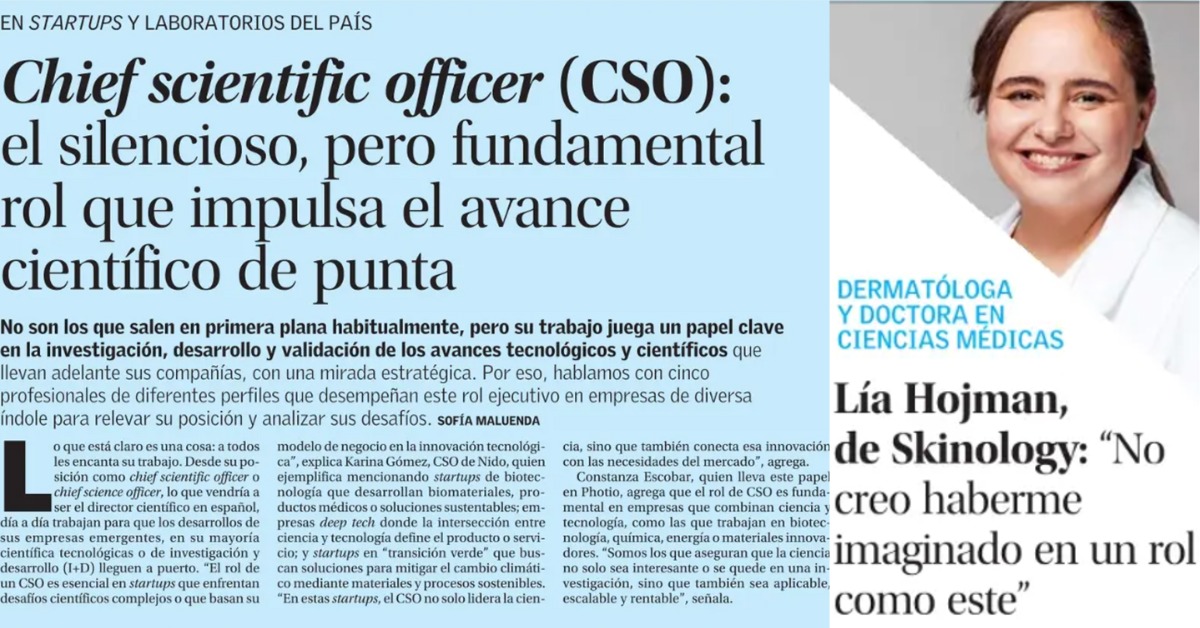
Lia Hojman is a physician, dermatologist, and PhD in Medical Sciences. She completed all her studies at the University of Chile. She is also the co-founder and Chief Scientific Officer (CSO) of Skinology, a skintech company that designs personalized skincare routines for every skin type by combining artificial intelligence with precision dermatology through its SkinQuiz.
“Many dermatologists have, at some point, considered launching their own skincare line, but I find this much more interesting than a traditional skincare line,” she says.
Among her achievements, she developed the first version of LIAM, an artificial intelligence-powered robot programmed to address users’ skin concerns in the same way she would. Based on the information it collects, LIAM generates an ultra-personalized skincare routine. Now, following the addition of a technology partner, the team has developed a new version that is more “robust, stable, and efficient.”
She believes that stepping outside one’s comfort zone is one of the most exciting and challenging aspects of entrepreneurship. “I love working with the pharmaceutical chemists who develop our formulas, people with a business background like my partner Antonia, designers, and advertising professionals. It is also incredibly exciting to help program our AI robot and learn a little about how an engineer like my partner Pablo thinks,” she explains.
“Physicians generally have many opportunities to develop their careers, one of which is serving as a technical director. However, my clinical colleagues typically pursue this role in hospitals, medical centers, health insurance companies, and similar settings. To become a CSO specifically, I believe that combining clinical training with a scientific background is highly relevant, although I never imagined myself in a role like this,” she says. She also agrees that, in science- or healthcare-related startups, the role may be quieter, but it is “essential.”
By Sofía Maluenda
Innovation – El Mercurio